

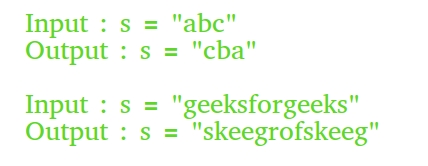
String reversal is reversing the order of characters in a string. In other words, it involves changing the sequence of characters from the original series to its reverse. This concept is widely used in programming and has various applications.
String reversal is an important concept in programming because it allows developers to manipulate and transform strings differently. It is a fundamental operation that can solve various problems, such as checking for palindromes, encrypting and decrypting data, and using text in multiple ways.
Understanding the Basic Concepts of Java Programming
Java is a popular programming language widely used for developing a wide range of applications, from web and mobile applications to enterprise software. It is known for its simplicity, portability, and robustness.
In Java, the basic syntax consists of a combination of keywords, operators, and symbols that define the structure and behavior of a program. The language supports various data types, including primitive types such as integers, floating-point numbers, characters, and booleans, and reference types such as arrays and objects.
Why Reverse a String in Java?
There are several common use cases for string reversal in Java programming. One common use case is checking whether a string is a palindrome. A palindrome is a word, phrase, number, or other sequence of characters that reads the same forward and backward. We can determine whether it is a palindrome by reversing a string and comparing it to the original series.
Another use case for string reversal is encrypting and decrypting data. Reversing a string can be a simple encryption technique to obfuscate sensitive information. We can solve the data and retrieve the original report by changing the encrypted column.
String reversal also has benefits in terms of code readability and maintainability. By reversing a string, we can manipulate and transform it differently, making performing various operations on the line easier.
Simple Techniques to Reverse a String in Java
There are several simple techniques to reverse a string in Java. One common technique is to use a loop to iterate through the characters of the string and build a new string in reverse order. Here is an example of how to reverse a string using a loop:
“`Java public static String reverse string(String str) {
String reversed = “”;
for (int i = str.length() – 1; i >= 0; i–) {
reversed += str.charAt(i);
}
return reversed;
}
“`
Another technique to reverse a string is to use recursion. Recursion is a programming technique where a function calls itself to solve a problem. Here is an example of how to reverse a string using recursion:
“`Java public static String reverse string(String str) {
if (str.isEmpty()) {
return str;
}
return reverseString(str.substring(1)) + str.charAt(0);
}
“`
Using Built-in Java Functions for String Reversal
Java provides built-in functions for string manipulation that can be used to reverse a string. One such function is the `StringBuilder` class, which provides methods for manipulating strings efficiently. Here is an example of how to reverse a string using the `StringBuilder` class:
“`Java public static String reverse string(String str) {
StringBuilder sb = new StringBuilder(str);
return sb.reverse().toString();
}
“`
Another built-in string reversal function is the’ StringBuffer’ class’s `reverse()` method. Here is an example of how to reverse a string using the `StringBuffer` class:
“`Java public static String reverse string(String str) {
StringBuffer sb = new StringBuffer(str);
return sb.reverse().toString();
}
“`
Implementing Custom Methods for String Reversal in Java
In addition to using built-in functions, developers can create custom methods for string reversal in Java. This allows for more flexibility and customization in the string reversal process. Here is an example of how to implement a custom method for string reversal:
“`Java public static String reverse string(String str) {
char[] chars = str.toCharArray();
int left = 0;
int right = chars.length – 1;
while (left < right) {
char temp = chars[left];
chars[left] = chars[right];
chars[right] = temp;
left++;
right–;
}
return new String(chars);
}
“`
Using custom methods for string reversal has several advantages. First, it allows developers to control the string reversal process more and customize it according to their specific needs. Second, it can improve code readability and maintainability by encapsulating the string reversal logic in a separate method.
Best Practices for Efficient String Reversal in Java
To optimize the performance of string reversal in Java, developers can follow several best practices. First, using the `StringBuilder` or `StringBuffer` class is recommended instead of concatenating strings using the `+` operator. This is because the `+` operator creates a new string object each time it is used, which can be inefficient for large strings.
Second, it is important to consider the memory usage when reversing a string. In some cases, switching a line in place may be more memory-efficient without creating an in-place object. This can be achieved using an array or `StringBuilder` to store the changed characters.
Third, it is recommended to use efficient algorithms and data structures for string reversal. For example, using a loop or recursion to iterate through the characters of a string can be inefficient for large columns. Using a stack or other data structure to reverse the line may be more efficient in such cases.
Debugging Tips for String Reversal in Java
When implementing string reversal in Java, errors and bugs are common. Here are some common errors and how to fix them:
– Index out of bounds error: This error occurs when trying to access an index outside the bounds of the string. To fix this error, check the bounds of the string before accessing its characters.
– Infinite recursion: This error occurs when a recursive function calls itself indefinitely. To fix this error, include a base case in the recursive function that stops the recursion.
– Incorrect output: This error occurs when the reversed string does not match the expected result. To fix this error, double-check the logic of the string reversal algorithm and make sure it is implemented correctly.
To debug string reversal in Java, developers can use various techniques such as printing intermediate values, using a debugger, or writing test cases to verify the correctness of the implementation.
Advanced String Reversal Techniques in Java
In addition to the simple techniques mentioned earlier, advanced algorithms for string reversal can be used in Java programming. One such algorithm is the two-pointer technique, which involves using two pointers to swap characters from both ends of the string until they meet in the middle.
Another advanced technique is using bitwise operations to reverse a string. This technique involves converting each string character to its binary representation and then changing the binary model using bitwise operations.
While these advanced techniques can be more efficient regarding time and space complexity, they may also be more complex to implement and understand. Therefore, it is important to consider the trade-offs and choose the appropriate technique based on the application’s specific requirements.
Real-World Applications of String Reversal in Java Programming
String reversal has various real-world applications in different industries and fields. In data encryption, string reversal can be used as a simple encryption technique to obfuscate sensitive information. By reversing the encrypted string again, the original information can be decrypted.
In natural language processing, string reversal can manipulate and transform text in various ways. For example, it can be used to reverse the words in a sentence or the order of characters in a comment.
In web development, string reversal can implement features such as password reset functionality or URL rewriting. By reversing a string and using it as a unique identifier, developers can ensure the security and uniqueness of the generated tokens or URLs.
In conclusion, string reversal is a fundamental concept in Java programming that allows developers to manipulate and transform strings differently. It has various applications in other fields, from data encryption to natural language processing. Several techniques for string reversal in JJava include loops, recursion, built-in functions, and custom methods. By following best practices and debugging tips, developers can optimize the performance and correctness of string reversal implementations. Furthermore, advanced techniques and real-world applications demonstrate the versatility and importance of string reversal in Java programming.

